Editor’s Note: When I originally reported this article in 2014, a pound of ground beef cost roughly $3.50. Now that same amount of protein costs you $6.75. But nothing about buying beef wholesale has changed: You will still save more money over time if you purchase an eighth, a quarter, a half, or even a whole cow given you have the upfront cash and deep freezer space to store it all. (A quarter of a cow from the same farm I purchased mine now costs $1,100, in case you were wondering.)
And, if you can spring for grass-fed beef, there’s been more recent published research to show that it might be healthier for you than the grain-fed variety. In 2022, South Korean researchers found that grass-fed beef contained a healthier fatty acid profile than grain-fed beef. Same goes for a 2026 study published in the Journal of Animal Science*.*
While eating healthier is great, doing so has to taste amazing too. Luckily that hasn’t changed about grass-fed beef either.
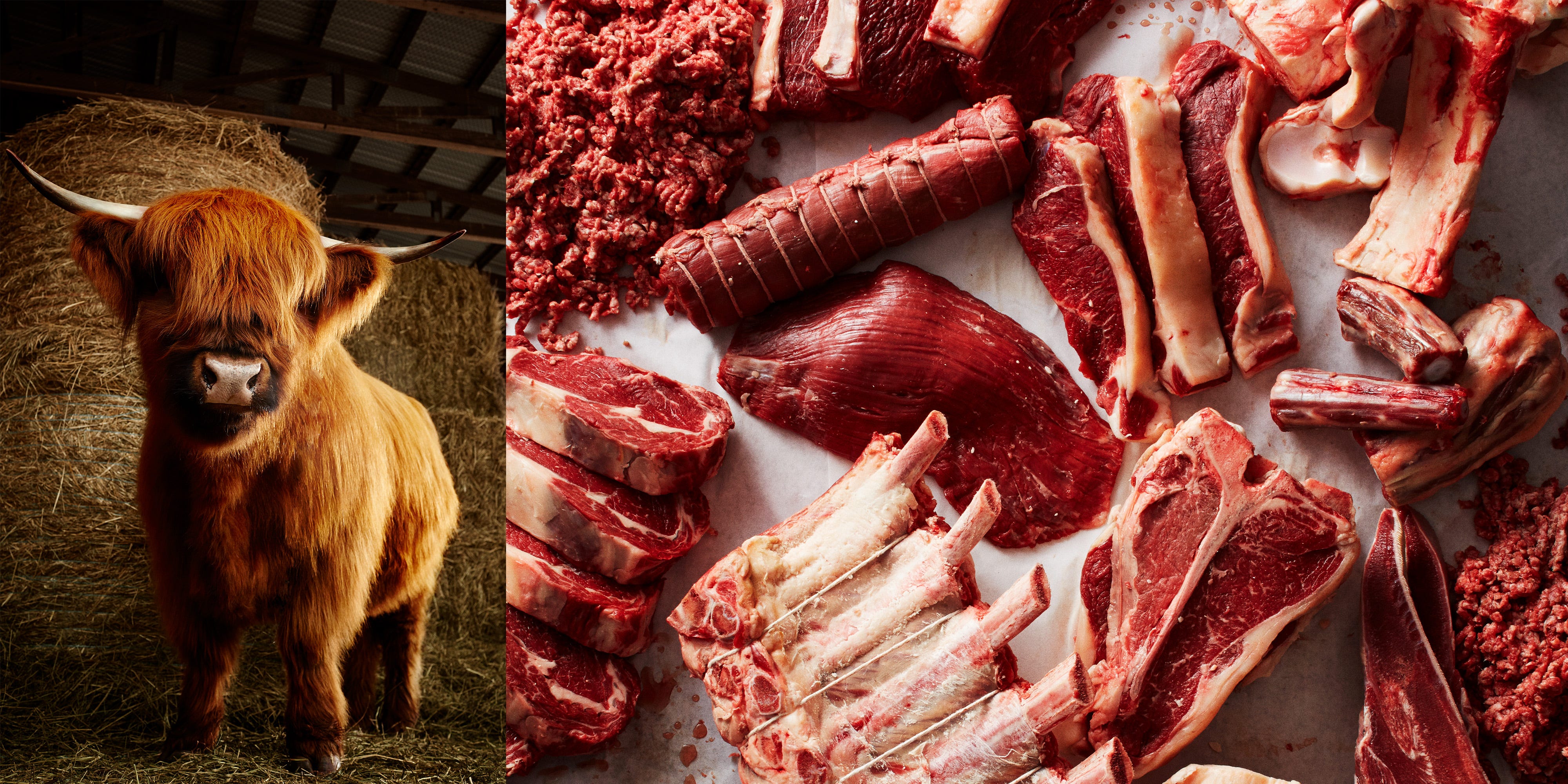
THE COW I ate was born in rural Pennsylvania. Cathy Pomanti, the owner of Sugar Hill Farm, midwifed my calf into the world. Pomanti raises grass-fed organic Scottish Highland Cows, a shaggy breed yielding meat that’s among the tastiest on the planet. On one farm visit, my fiancee saw a highlander, went quiet, and then said, “I don’t want to eat them. I want to hug them.” But I was hungry for a cow to call my own.
I’m a pleasure-seeking meat eater, and I was disappointed by grain-fed supermarket beef. Rib eyes require a slick of steak sauce to taste meaty. Ground beef has a tacky, greasy consistency. Tenderloin, even with tender care, always leaves me underwhelmed. So I decided to stop complaining about mass-market beef and find a rancher. I wanted to know my cattle producer. I wanted to know my cow.
My cow never had a name; Pomanti can’t bring herself to name cows headed for slaughter. But he did have a good life. My cow spent his first 10 months growing strong on his mother’s milk, sticking close by her side. Then Pomanti separated my cow and his mother into different pens. My cow bawled. His mother mooed. It was for the best. Once Mom stopped producing milk, the two were reunited, but my cow now preferred delicious, nutritious grass.
Over the next year and a half, my cow grew an impressive coat of thick, coarse hair. Because he wouldn’t be subjected to the diseases and indignities of the industrial feedlot, he didn’t need antibiotics or growth hormones. Those substances wouldn’t end up in me or my fiancée, either.
Last October, my cow was loaded onto a truck and taken to Rising Spring Meat Company, an organic butcher outside State College, Pennsylvania. There he was held in a pen, calm and comfortable, until he was humanely shot in the head. The carcass was then halved and hung in a cooler to dry-age, a process that helps tenderize the meat, for about 14 days. Next my cow was cut into pieces, vacuum-sealed, and delivered to Pomanti.
She summoned me for the handoff. Out of her massive freezer units she pulled bags bursting with marrow bones, globular ground beef portions, and a tenderloin the size of Popeye’s forearm. I drove the box of beef back home that day, dreaming of meals to come, under a sky with clouds that looked like heifers.
The Beef with Beef
AS A TYPICAL American, you ate a hefty 51 pounds of beef last year, the USDA says. That’s roughly the equivalent of 65 T-bones or 204 quarter-pound burger patties.
The National Cattlemen’s Beef Association notes that less than 1 percent of beef sold at retail is labeled as grass-fed. During the “finishing,” the animal begins to lay down more fat in relation to muscle and bone growth, says Cindy Daley, Ph.D., who studies beef at California State University.
Until the 1950s, ranchers finished cattle exclusively on grass. But industrial producers realized that grain feeding improved fat marbling while cutting the days until slaughter. After decades of eating the stuff, we now prefer fattier beef. But at the same time, our rates of diseases linked to inflammation rose.
Could grain-fed cows and inflammation be connected? A 2011 Irish study found that people who replaced their regular red meat with three weekly servings of grass-fed red meat for a month improved their inflammation-fighting omega-3 fatty acid profiles by 37 percent over those of people who ate the same amount of grain-finished red meat.
Though the diet studies are too small to be conclusive, a 2010 research review led by Daley found that grass-fed beef outclassed grain-fed nutritionally, with triple the immune-boosting vitamin E, up to five times the heart-healthy omega-3 fatty acids, and seven times the antioxidant carotenoids.
If grass-fed beef was going to treat me better, I needed to return the favor. So I began contacting chefs. The recipes that follow taught me key kitchen skills, but they also taught me something deeper: If you know your beef, you love it even more.

The Oxtail
Red Wine Beef Stew
THERE’S A CERTAIN comfort in dissociating yourself from the animal you’re eating for dinner. If you don’t think about where on the cow’s body the meat comes from, you don’t have to contemplate the death and dismemberment involved in its trip to your plate. The oxtail, however, made a very specific statement about its origins. It came to me in three pieces, which, because of my morbid curiosity, I arranged to reconstruct the entire appendage. I imagined my cow using it to swat flies. It wasn’t simply a meal. It was a sacrifice.
Alice Waters, executive chef of Chez Panisse in Berkeley, California, and founder of the Edible Schoolyard Project, recommends cooking oxtail in a classic braise. “With grain-fed beef, you’re tasting a richness and tenderness, but it’s not the real flavor,” Waters says. “It’s like cooking vegetables with a lot of butter: You can’t taste the vegetables.” Her technique, inspired by a recipe from Zuni Café in San Francisco, matches the beautiful beefiness of the rustic cut with a slow, patient braise in red wine, letting the true flavor of grass-fed beef come through.