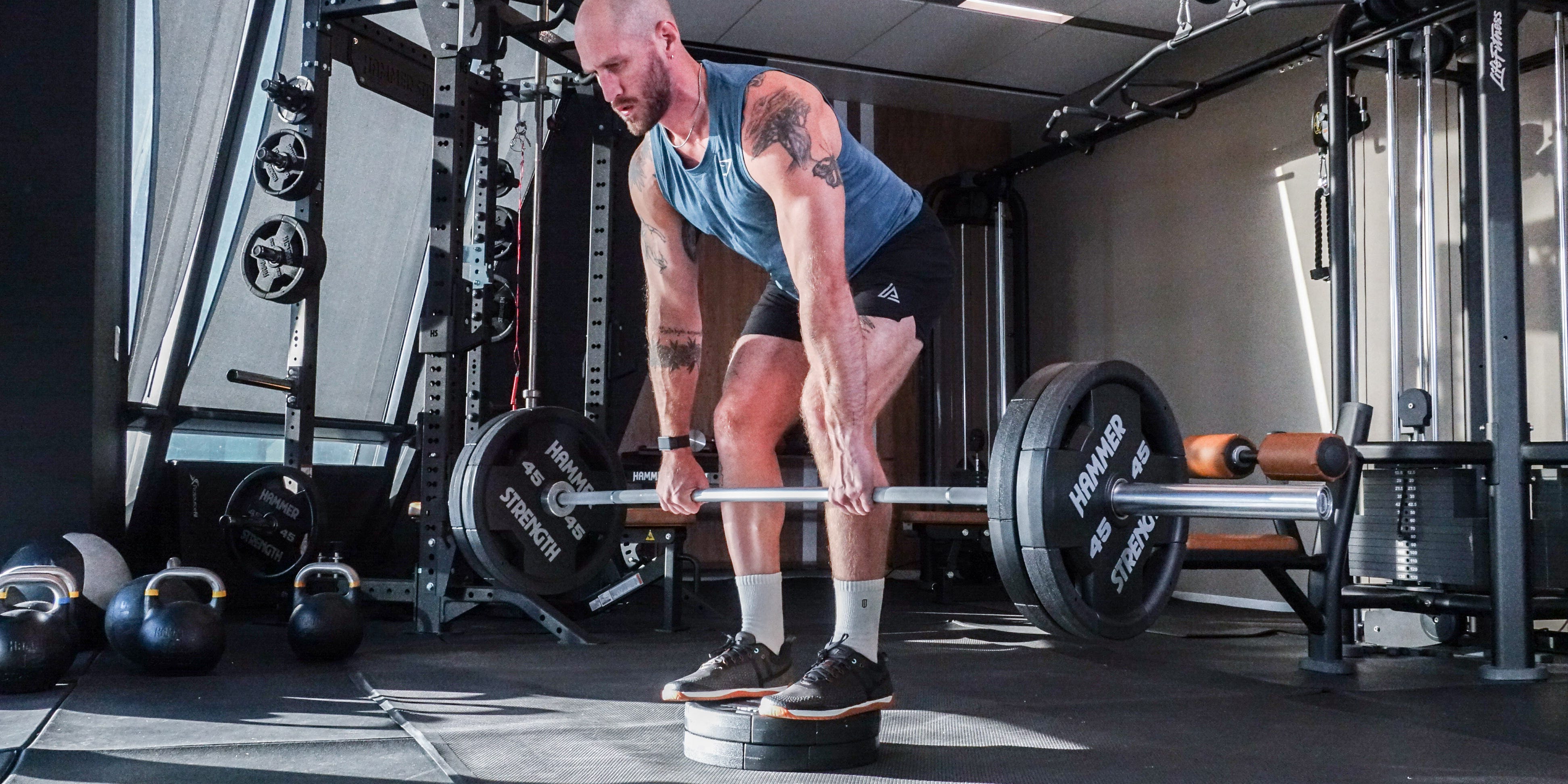

Little changes can yield big results. If you’re working to set new strength standards and push through weight room plateaus, movements like the deficit deadlift stand as testament to that sentiment. The exercise is identical to the traditional barbell deadlift, with one key distinction: you stand on a slightly elevated surface—just a couple of inches—as you pull the weight off the floor.
There’s a good chance you haven’t tried this variation before. It’s more popular among strength athletes, like powerlifters and strongmen, who toil over every minute detail of their deadlift technique to gain a competitive edge. But just because you haven’t done it doesn’t mean you shouldn’t. Whether you’re looking to shake up your routine or address a specific weakness in your deadlift, this simple adjustment is worth trying. Here’s what you need to know.
Why You Should Do Deficit Deadlifts
Deficit deadlifts extend the range of motion of the pull by the height of whatever you’re standing on, usually an inch or two, making the lift more demanding. Athletes who train for strength sports typically add deficit deadlifts to their programs when they’re having trouble pulling heavier weights off the floor.
Say you can deadlift 315 pounds, but can’t budge 335. You might be struggling to produce enough force during the initial pull. By standing on an elevated surface, you’re forcing the muscles responsible for getting the bar moving—primarily your glutes and quads with a little help from your hamstrings and lower back—to work through a greater range of motion.
The extra demand on these muscles “can potentiate more muscle growth and greater strength—especially grip strength,” says Lee Boyce, a Toronto-based personal trainer, college professor, and owner of Boyce Training Systems. “Reaching down further than normal to pick up a bar also means more quadriceps activity, due to the greater knee bend that’s required to do so. Transitioning back to a standard deadlift after a phase of deficit work can give the normal stuff the chance to feel ‘easy’ by comparison.”
This concept isn’t simply theoretical. A small study of 20 experienced lifters compared conventional deadlifts, deficit deadlifts, and rack pulls (which have you lifting a heavier weight than you can deadlift over a smaller range of motion). Researchers found more quad and glute activation during deficit deadlifts. The study measured only muscle engagement, not whether that engagement leads to greater muscle growth. Still, what’s clear is this: deficit deadlifts offer another way to challenge your lower body without introducing an entirely different movement.
Boyce says deficit deadlifts can also be a good fit for shorter lifters who want a longer pulling range. “Being shorter means the bar will ‘start’ higher up the leg, making for a shorter range of motion and a pull that may not be as fulfilling,” he explains. “Standing on a platform or a couple of plates can fix this problem.”
That won’t work for everyone, though, especially beginners. Celebrity trainer Don Saladino likes deficit deadlifts but says the added mobility demands mean they’re not a good fit for every lifter. “I work with plenty of people who lack the mobility or control to deadlift properly from the floor, and so why would I increase their range of motion?” he noted. “In many cases, I’m doing the opposite. I’m elevating the bar to help them achieve a stronger, more controlled starting position.”
Deficit deadlifts demand more mobility in your hips and ankles since you’re reaching farther down to grab the bar. If you’re excessively rounding your lower back to get into the starting position or your hips shoot up before the bar leaves the floor, you need to address those form issues before diving into deficit deadlifts. Try lifting from a smaller deficit or skip the exercise altogether. Dedicated hip mobility work may help you get there, but deficit deadlifts aren’t a must-do exercise. There are plenty of deadlift variations to choose from, and the best one is the one that suits your abilities and training goals.
How to Do the Deficit Deadlift
The deficit deadlift is more of a modification than a distinct exercise. The instructions below focus on the barbell version, but you can perform just about any type of deadlift from a deficit, including dumbbell deadlifts, kettlebell deadlifts, and trap bar deadlifts.
Step 1: First, establish an elevated surface to stand on. Some strength gyms have dedicated platforms for deficit deadlifts. Make sure the surface is stable and large enough to accommodate your stance.
Step 2: Stand on the elevated surface in front of a loaded barbell, positioning the bar over the middle of your feet. Grab the bar with an overhand grip, just outside your legs, then bend your knees until your shins touch the bar. Keep your chest up, shoulders back, and spine neutral as you settle into the starting position.
Step 3: Take a deep breath, brace your core, and drive through the floor as you pull the bar upward, keeping it close to your body throughout the lift. Lead with your chest rather than your hips to avoid early lower-back rounding.
Step 4: Lock out at the top by squeezing your glutes and standing tall, then lower the bar back to the floor with control, maintaining a neutral spine on the way down.
Because the deficit increases the range of motion and the demands on your mobility, start with a lighter load than you would use for a standard deadlift. A deficit of one to two inches is enough for most lifters to feel the difference without compromising form.