AS THE CURIOSITY around peptides grows, the FDA has made efforts in removing a portion of the 19 synthetic peptides from the Category 2 Bulk Substances List. This is kind of a huge deal because when the FDA classifies a substance as Category 2, they believe that it carries significant safety risks and prohibit compounding pharmacies from making it.
In July 2026, an FDA advisory committee met to evaluate evidence for seven popular synthetic peptides on the Category 2 list and recommend whether the FDA should move them onto the Category 1 list, which allows them to be made. Another five will be under review in 2027. The FDA is not bound to the advisory committee’s recommendations.
The panel voted to loosen the restrictions on BPC-157 and TB-500 (those make up the infamous “Wolverine Stack”), as well as KPV, MOTS-C, Epitalon, and Semax. It voted no for Emedeltide — that’s the one people reach for to help their sleep. None of the compounds scored a unanimous vote. This October, US Health Secretary Robert F. Kennedy Jr. pushed forward a policy to temporarily increase access to these six unapproved peptides. The government will not penalize licensed pharmacists in compounding pharmacies for creating and distributing these substances for people with a prescription. The nudge from RFK Jr. to allow the temporary sale of peptides has received mixed reactions.
“The American Peptide Association applauds the efforts of the Trump Administration and HHS to green light certain peptides into production by compound pharmacies,” Jeff Cohen, cofounder of the American Peptide Association, wrote in an email to Men’s Health. “It is much needed clarity that the peptide industry, clinicians and consumers have hoped and worked for for the past couple years and is a bold step outside the usual pharma driven, FDA managed pathway.”
Motisola Lewis, MD, is an internal medicine physician who runs her own concierge medical practice. While she focuses on providing personalized care to her patients, she doesn’t agree with expanding access to unapproved peptides before having adequate evidence of their safety and effectiveness. “I want patients to have access to promising treatments, but I also want those treatments to be supported by good science. My concern is that the enthusiasm around peptides has moved much faster than the clinical evidence.” For Dr. Lewis, several questions remain unanswered: do these peptides actually work and for whom, peptide quality especially from third-party suppliers, and who is in charge of oversight. That doesn’t mean she is unwilling to discuss peptides, which is happening more than ever.
Sritha Rajupet, MD, MPH, chair of the department of family, population, and preventive medicine at Stony Brook Medicine, also has concerns. “Most of these peptides still lack high-quality human data on safety, effectiveness, and appropriate dosing,” Dr. Rajupet says. Meaning that even if the FDA removes the Category 2 label, there’s still not a lot of research around if and how they work — along with any side effects. In the document outlining RFK Jr.’s new policy, compounding pharmacists must report “serious adverse events, and product quality issues to FDA and to the States where the products are compounded.”
Still, Dr. Rajupet acknowledges that people are interested in synthetic peptides — and many are already obtaining them through unregulated channels.
Kent Bradley, MD, chief medical officer at 10X Health, which offers synthetic peptide therapy, sees this firsthand. “Many of the people reaching for peptides have already exhausted conventional options,” he says. “The issue we are seeing is that individuals may have gotten a peptide without going through legitimate quality checks of a compounded pharmacy and self-administering based on information they are seeing off of social media.”
The world of synthetic peptides is promising, for sure. But there are dangers — some of which are serious (ahem, cancer). Dr. Rajupet says that in order for consumers to protect themselves, they have to study up.
“From a clinical perspective, the priority is balancing harm reduction with scientific rigor — engaging patients in open, nonjudgmental conversations while being clear that many of these therapies remain experimental, with uncertain risks and benefits,” says Dr. Rajupet.
For this reason, we created a one-stop glossary to help answer your questions about the current peptide landscape. Here’s the hype — and the actual science.
What Are Peptides?
Peptides exist naturally. Technically, they’re short chains of amino acids — the building blocks of protein. And not just the kind of protein that builds biceps. Proteins can also act as messengers throughout your body, doing everything from signaling the release of a particular hormone to regulating inflammatory responses.
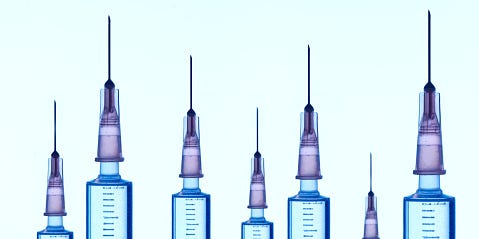
But when we’re talking about the kind of peptides the FDA will consider for deregulation, we’re talking about synthetic peptides delivered through sprays or injection. These drugs work to trigger the same responses as natural peptides, but the science is in its very early stages. Anecdotal reports from people who take peptides describe improvements in health, appearance, and muscle performance. But, again, anecdotal.
The 12 Peptides That May Be Legal
These are the synthetic peptides that the FDA will consider for deregulation in 2026 and 2027, broken into categories based on their supposed health benefits. Each receives a thumbs up, thumbs down, or thumbs “meh” to rate just how much the science backs up the supposed benefits.
Metabolic Health
AOD-9604 (Anti-Obesity Drug 9604)

AOD-9604 is a synthetic fragment of human growth hormone originally developed as an anti-obesity drug. Early animal studies suggested it could stimulate fat breakdown and inhibit fat formation, but clinical trials in humans did not demonstrate significant weight loss. The compound failed to gain FDA approval for obesity treatment, and robust human evidence supporting its use remains lacking.
As with all substances discussed in this glossary, consult a qualified healthcare provider before considering any peptide therapy. Many of these compounds are still experimental and lack comprehensive human safety data.