
The standard barbell bench press is an all-time chest exercise for good reason. The compound move allows you to push big-time weight and build chest muscle, checking boxes for both performance and aesthetic goals. If you want to level up your chest day workouts and fine-tune both your muscle and strength gains, though, it pays to change up the angle. That’s what you do with the dumbbell incline bench press.
You’re not just messing around with your adjustable bench settings for variety’s sake. When you adjust your pressing angle, you’ll shift the focus to the upper part of your chest — and this will make your standard bench press even stronger.
Before you grab a set of dumbbells, hit the bench, and get pressing, take note that it’s extremely important to pay attention to the movement here — particularly because of how easy it is to cheat the angle and how common it is for guys to put their shoulder health at risk.
Men’s Health fitness director Ebenezer Samuel, C.S.C.S. and senior editor Brett Williams, NASM guide you through the cues you need to know to do the dumbbell incline press right.
How to Do the Dumbbell Incline Press
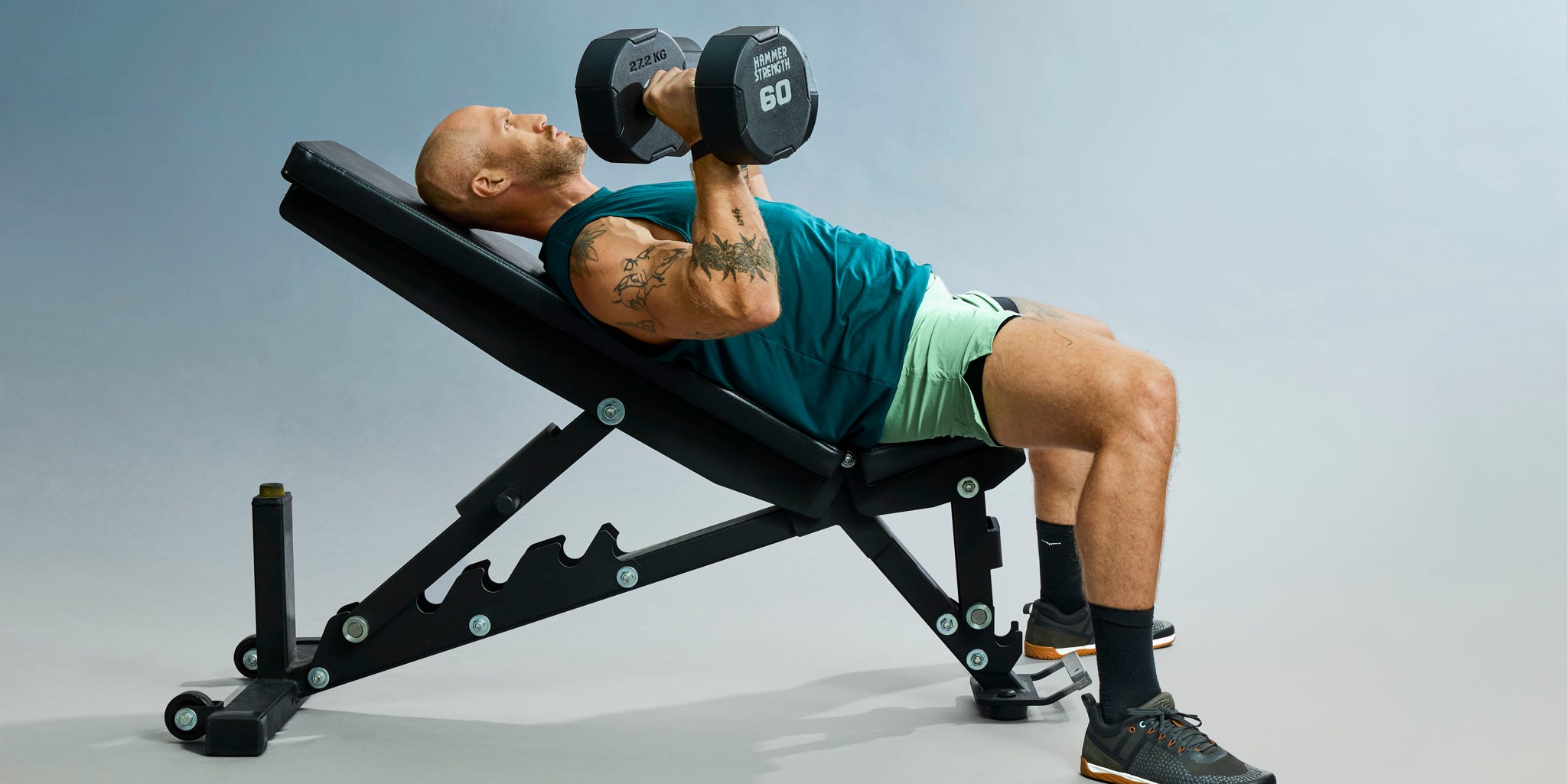
- Sit on the incline bench set to a 45 to 60 degree angle holding a set of dumbbells. Drive your feet into the floor, drive your glutes into the seat, squeeze your abs, and drive your shoulders into the back pad.
- Raise the dumbbells to your shoulders. If the weight is too heavy, use your knees to kick the bell up. Your forearms should be perpendicular to the floor.
- Press the weight straight up, keeping your upper arms perpendicular to the ground.
- Once the weight is up, drive your shoulders down to create tension. Shift the angle of your arms by turning your hands slightly in.
- Lower the weight back down toward your chest as your chest flexibility allows, at least until your elbows are below your shoulders.
Follow these tips from Samuel for more detailed form cues.
Abs Tight
Eb says: You’ll see a lot of people arching their backs when they bench press — and it’s that much more important on the incline press. If you’re aiming to hit the clavicular fibers of your chest (your upper chest), you need to create a wider upper arm angle relative to your torso. The incline press does that if you keep your core tight and don’t arch your back.
Arching your back closes that upper arm angle (and cuts the distance of the actual press too), which defeats the purpose of the exercise. So keep your core tight and glue your butt to the bench. These are common bench-pressing rules in general, but they need reinforcement when you’re on the incline press.
Forearm Angle
Eb says: One of the most common mistakes on the incline press occurs when people slightly press out in front of them instead of pressing straight up. This happens because they misunderstand the purpose of the press. Again, you’re here to open up the upper arm angle relative to your torso, not to simply lie on the bench at a different angle.
Set up for this the way you would for any bench press: dumbbells directly above shoulders, then drive your shoulders hard into the bench to tighten your shoulder blades. Turn your elbows slightly forward and you’re ready to go.
Don’t Overdo the Depth
Eb says: Yes, it’s great to touch the dumbbells to your chest, but don’t fixate on that idea. Depending on your shoulder mobility, you may or may not be able to do this. Your goal should be to lower the dumbbells until your elbows are below your shoulders at least, and you should be able to own and control this position.
If you can’t reach your chest, that’s OK. Once your elbows have dipped below your shoulders and you’ve proven you own this position, press back up explosively. The focus is on the powerful press back up and the squeeze at the top of each rep — if you wanted to stretch your chest fibers, you’d simply do a chest stretch.
Benefits of the Dumbbell Incline Press
By changing your pressing angle, you’ll target the muscle fibers in your upper chest, according to Samuel. You’ll build strength and muscle in a slightly different way than you would with the standard flat bench press.
Using dumbbells also provides advantages over barbell pressing variations. You’ll be able to work through a larger range of motion since your hands aren’t fixed on a bar, and your shoulders can move in a more comfortable position in the scapular plane. Dumbbells also offer the opportunity to introduce alternating or unilateral press variations, which allow for more time under tension — and more muscle-building stimulus.
Muscles Targeted by the Dumbbell Incline Press
The dumbbell incline press primarily works your chest, and more specifically the muscle fibers in the upper region of the pectoral group.
Since it’s a pressing movement, your triceps will also be involved, as will your shoulder muscles such as your front delts. Maintain proper posture on the bench throughout the movement to keep the emphasis on your upper chest.
How to Add the Dumbbell Incline Press to Your Workouts
Make the dumbbell incline press the second movement in your chest day workout, just after a flat bench pressing variation. Start with 3 to 4 sets of 8 to 10 reps, and focus on controlling both the descent and the explosive press back up to get the most out of each set.