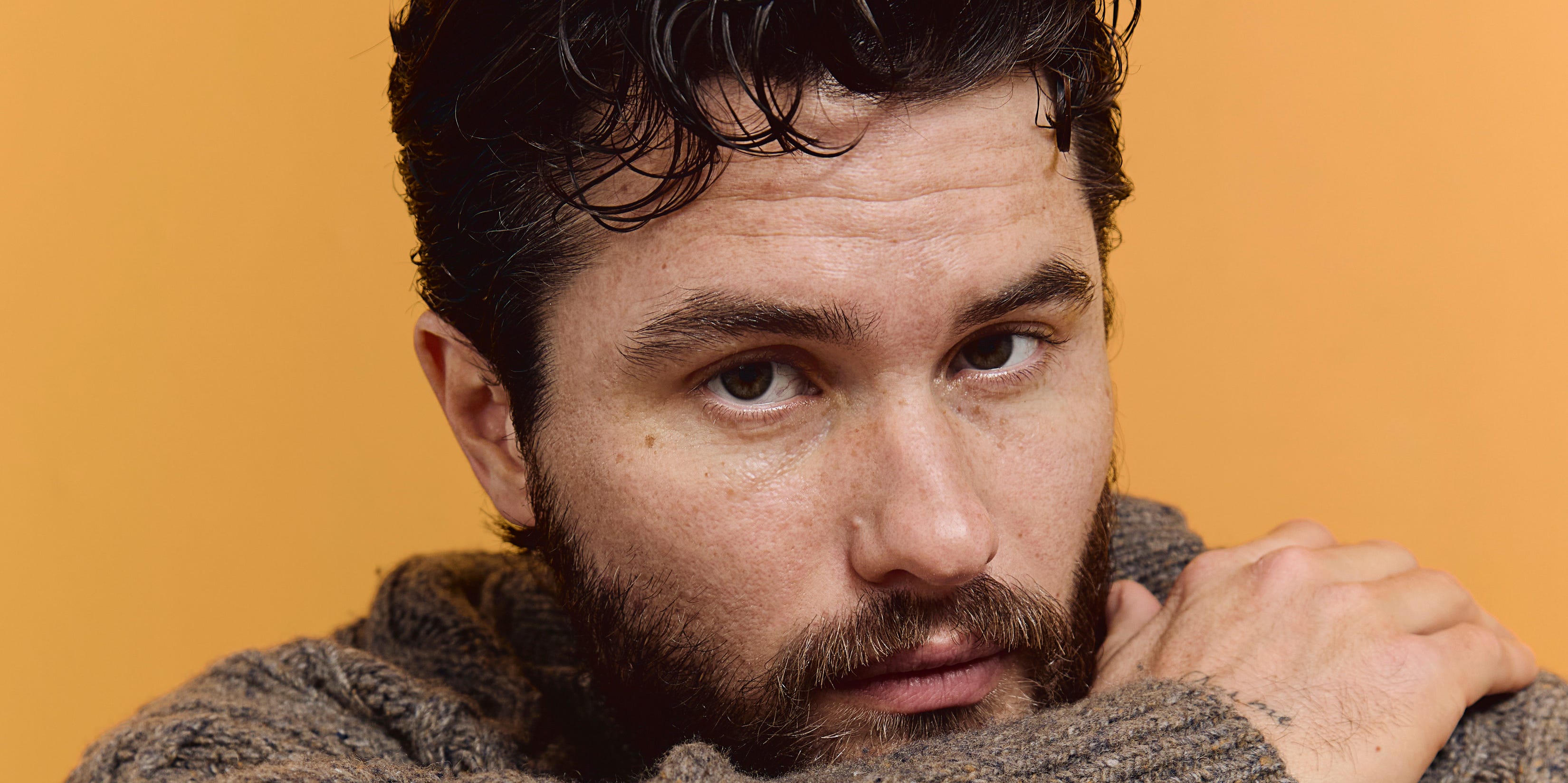
As a bright light flashes against a mustard yellow backdrop, 33-year-old actor Chase Stokes plays with the edges of a chunky sweater. First, he pulls on a sleeve, like he’s simply at home getting dressed, not on the last day of a long press tour for the fifth and final season of his hit TV show.
When the camera isn’t flashing, the Outer Banks leading man is looking around at the floor, at the wall, at his hands — anywhere but the computer monitor where each new photo appears. He mostly just whistles or hums along to the background music, a mix of ’70s and ’80s soul funk. He is, it seems, trying not to be a bother. Either that, or he just wants to get the shirtless shots done with so he can eat lunch before wrapping up with two back-to-back podcast tapings.
Eventually, Chase sits on the fake wooden floor and pulls the sweater collar up to cradle his jaw, as if it were an expensive emotional support blanket. Maybe it is. But then, he takes it off.
The body underneath is not the lean, surfer-boy build of John B. Routledge, but the larger, more muscular frame of a wide receiver. Offhandedly, he makes a joke about how he’s no longer “starving himself to play a teenager,” in between smoldering stares at the camera.
Later, in a glass-walled conference room, Chase says that transforming his body has been not just a physical “metamorphosis,” but also an emotional one. “I’ve always kind of struggled with body dysmorphia. I’ve gone through a lot of scrutiny and a lot of condescending stuff on the internet over the years about my body, and it’s really messed with my mental health at times,” he says. “It’s been nice to leave that because that character has been put to bed. Now, we get to start fresh, and we get to build something that is really cool and entirely different.”


He’s ready to say goodbye to “the blonde-haired boy with the six-pack abs” and reintroduce himself to the world. “Although it’s a beautiful thing to know that this character exists in that way, it’s terrifying because I’m an artist,” Chase says. “I just want the world to see me. That’s a scary, vulnerable thing.”
Men’s Health spoke to Chase about growing up, moving on, and finally feeling at home in his body.
MEN’S HEALTH: What question do you wish interviewers would ask you more?
CHASE STOKES: I love when people ask like, “Hey, how was your personal experience while filming this?” It’s such a beautiful thing to see the end result and to meet the character, but there’s still the human behind the scenes that is excited to talk about the process. I think, sometimes, that gets left out of the conversation, and instead it’s just like, “Tell me about the character, the character, the character.”
MH: During the photo shoot, you mentioned starving yourself to look like a teenager. What happened there?
CS: Yep. When I was doing Outer Banks, I was intermittent fasting almost until two o’clock every day, just so I could keep the weight off with John B., and I was drinking upwards of a gallon of water in that time to keep myself full.
Now, I wake up at 7 a.m., fast until 10 or 11, and have a hearty breakfast. Then, I go to the gym, and when I come back, I have a protein shake. Later, I have another oomph of protein.
MH: Is this body change also kind of a way for you to send a signal to the industry?
CS: Yes, very much so. I’m 33 years old. I’ve been playing a teenager through my late 20s and early 30s. I’m sort of already in the box of John B., so I was like, okay, I need to do something. I need to show the world that I am not a child with floppy, blonde hair. It’s salt and pepper now. I have a beard. I’ve always loved when artists or human beings go through transformations.
So, when I got the role of Ronnie Whitlock in Thunder Road, I knew I wanted to honor the world of NASCAR and the people who are out there in the field. This character is a rear tire changer, and those guys are ex-Division I athletes — a lot of them have played professional ball in other areas. So, if I came in at the size of John B., that would be incredibly disrespectful to so many people who love this sport and those who are still operating at a professional athlete level physically to make sure that car goes into the pit lane, gets up on a jack, and goes out in the blink of an eye.
So, there’s that, and then also, I just want the world to see me. That’s a scary, vulnerable thing to say.
“The internet falls in love with the blonde-haired boy with the six-pack abs and then wonders why I don’t always look like that.”
MH: A lot of people probably overlook the physicality of being in a pit crew.
CS: People don’t realize how heavy a tire is for a car at that level. Or a jackman who has to lift a car — they get one pump to get that car off the ground in the right timing. And then the physicality of getting over the wall at the right time, getting to the wheel, getting the jack in, getting the tire off, getting another tire on. Those movements are so pivotal, and every tenth of a second matters.
So, you have to be an athlete. You have to be prepared every second that car comes into that lane. And even the drivers have to deal with the physically demanding nature and mental fortitude of driving four hours at 160-plus miles an hour with cars mere inches away from you. Racing is a very underrated sport when it comes to the endurance and physicality of it. I knew that, for John B., being a surfer in that dynamic, you are lean, you are a cardio machine. Now, I’m venturing into something different, and I have a responsibility to honor that world too.
MH: So, what do your workouts look like now?
CS: There was a lot of lighter weight, higher reps with John B. to keep that lean look, and now it’s a lot more heavy compound lifts — almost mirroring what a wide receiver, or even a tight end, would do. A lot of cleans, squats, Bulgarian split squats, deadlifts. I’m benching for the first time in a long time, trying to hit maxes. I’m really building out my frame, whereas with John B. I had to be kind of lanky and lean. It’s nice too because I get to eat a lot more.
Since I’ve put on the majority of the weight, I’m now fine-tuning my body, which is a really cool concept. Working with great trainers and focusing on that kind of precision has made the whole process feel intentional rather than just reactive — a fitting approach for someone stepping into an entirely new chapter of his career.