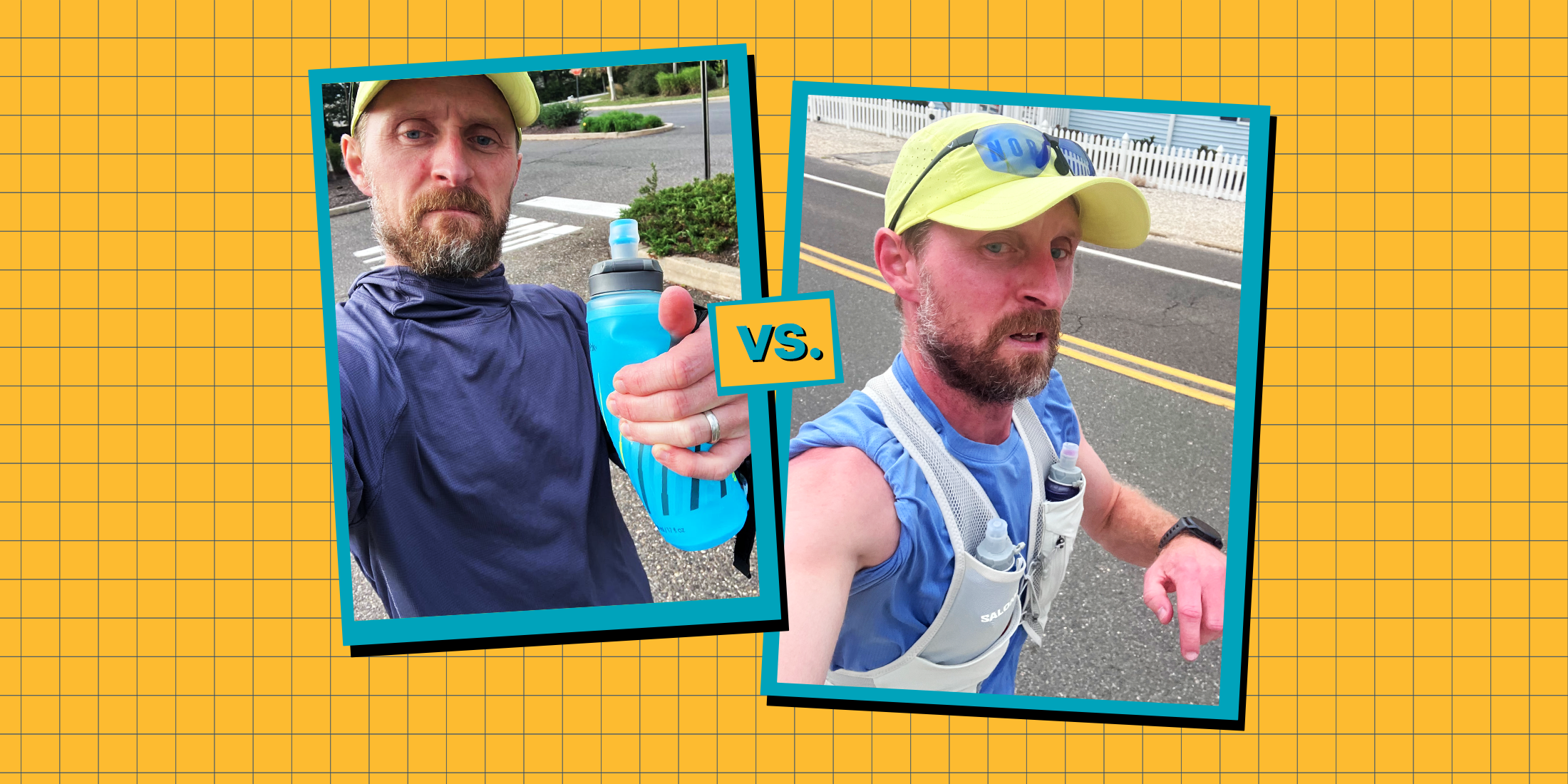
A big question for runners, even when you’ve been doing it for quite some time, is how to hydrate during longer runs. Training itself is one hurdle, but figuring out what you’re going to do during a race is an even bigger concern — unless you decide to just grab cups at water stations.
How much water should you even be drinking while running? The National Academy of Sciences’ official guideline on hydration recommends 3.7 liters of fluid per day for men. Since roughly 80 percent of our water comes from beverages, that rounds out to about 100 ounces of water per day. That number changes based on your size, activity level, and the temperature outside — and applies overall, not just while exercising.
For shorter runs — typically eight miles or under — many runners can avoid bringing water unless it’s hot out. But others can’t go without water on five-mile runs, so it’s subjective to the individual runner and something worth figuring out through a sweat rate test or online hydration calculators.
When training for longer distances, it’s worth testing hydration packs, vests, and water bottles to dial in a race-day setup. Here’s a breakdown of the main options.
Handheld Water Bottles

Handheld water bottles that strap to your hand are a budget option, require zero setup, and are simple to use. It’s essentially a soft flask with a strap you loop onto your hand.
The HydraPak SkyFlask Speed 500 mL performs well on runs from 8 to 12 miles, and having water on hand is especially useful in hot conditions. The sipping mechanism works like any other soft flask — you bite and suck the nozzle — and that part functions fine.
The drawbacks, however, are significant for some runners. Running with a bottle strapped to your hand takes getting used to, and it doesn’t suit every running style. At around mile 5, the hand holding the bottle can fall asleep, natural gait can be noticeably altered, and making any apparel adjustments mid-run becomes difficult. For runners who keep their arms close to their body with elbows collapsed, being hands-free is a priority — particularly when pushing pace.
Running belts with flask storage are another option in this category. They work well for shorter runs as long as the waistband is durable enough to prevent chafing. The downside is that they tend to bounce during a run, which is a dealbreaker for many runners.