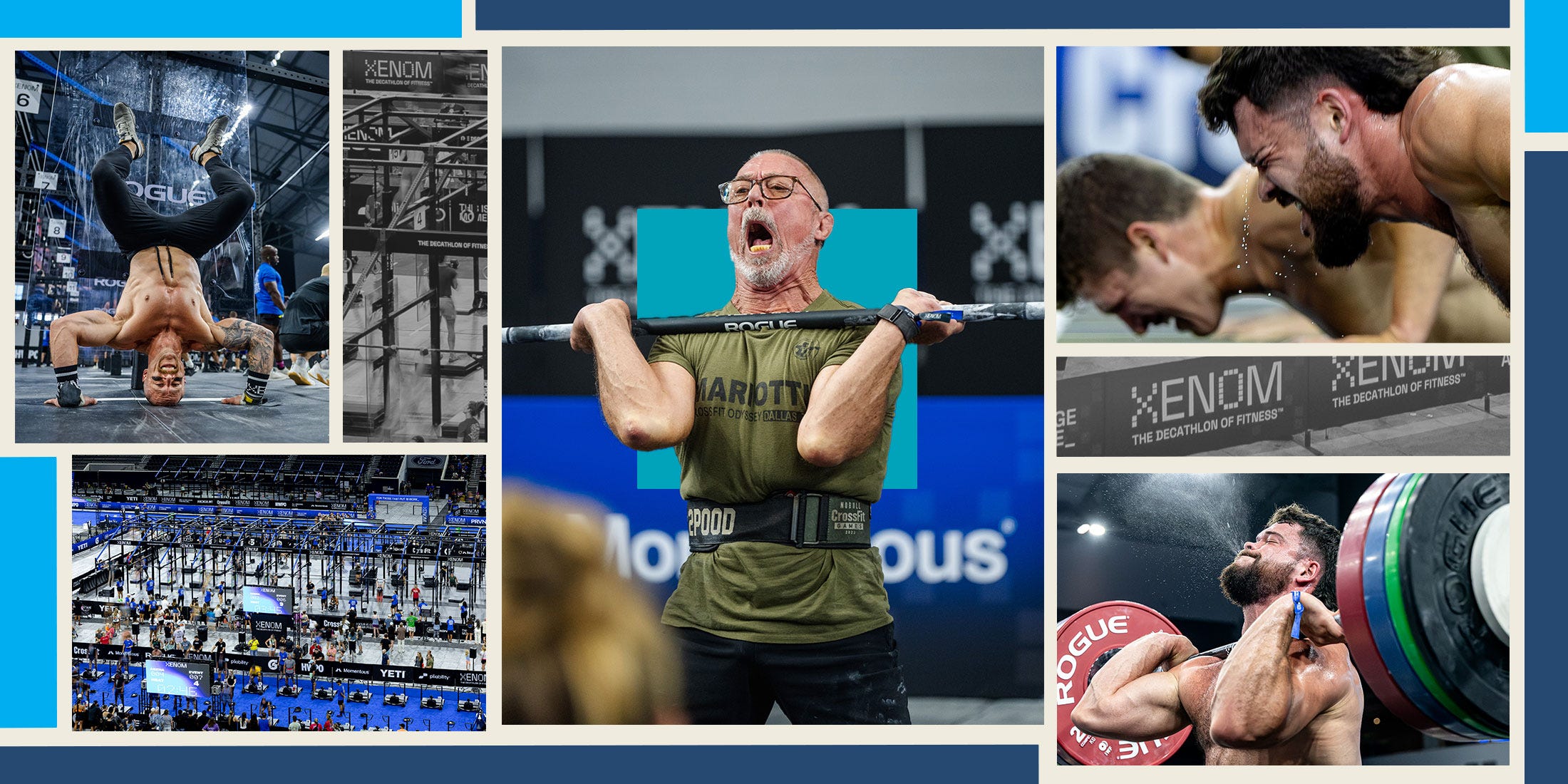

A middle-aged woman in a green tank top and black tights approaches a barbell loaded with a little more than 110 pounds. Electronic music blares through the Ford Center in Frisco, TX, the 510,000 square-foot headquarters and practice facility for the Dallas Cowboys. A judge raises his hand, and the woman pulls the barbell from the floor, catches it overhead, and fights for the lockout as her arms wobble beneath the weight. The rep is good. The barbell crashes to the floor. She screams in delight. A small group of friends frantically waves handwritten signs and cheers as if she has just won the whole event. She may as well have; it’s a lifetime personal best.
“That’s the highlight of her year, and now she’s a Xenom competitor for life,” Keith Barlow, founder of the new functional fitness competition, tells me from the floor of the inaugural event. “We want to give people their hero moment.”
She’s just one of over 250 athletes who traveled to the Lone Star State from around the world to try their hand at one of the newest additions to the growing roster of functional fitness competitions now populating gyms, convention centers, and your algorithm. Xenom, trademarked as “The Decathlon of Fitness,” consists of 10 events designed to test a competitor’s overall fitness. Over two days, participants run, snatch heavy weights, burn max calories on an air bike, and work through a blend of CrossFit staples like toes-to-bar, dumbbell snatches, wall walks, and rope climbs.
Across Xenom’s five “arenas,” men, women, and pairs cycle through heat after heat. A man lies supine on the floor, writhing from fatigue after a 5K blend of rowing and running, his mother wiping him down with a towel. A 50-something with a six-pack confidently tears through deadlifts, front squats, and overhead presses with 135 pounds — the same workout completed by pudgier competitors and scrawnier 20-year-olds. Parents cradling ear-muffed babies cheer on their partners from the sidelines. The floor is filled with people of all ages, body types, and fitness levels, unified by the same idea: testing themselves alongside the best, at the highest level of competition they can reach.

A Premium Competition with a Clear Target
Xenom’s pitch is to package the feel of an elite-level CrossFit competition into a mass-participation event that serious fitness hobbyists can put on their calendars year after year. By blending CrossFit’s training style and competition format with the standardization and production value of Hyrox, the running-forward fitness race that has exploded in popularity over the last couple of years, Barlow wants Xenom to feel premium, consequential, and worth bragging about — more like an Ironman than a local comp, the kind of accomplishment people travel for, talk about, and maybe even tattoo the logo on their bodies.
To create the event format, Barlow partnered with CrossFit Motion in the U.K. and commissioned a university to produce an NDA-protected report on how to test the widest range of fitness in the most accessible way. Xenom borrows from traditional decathlon ideas: 10 events, each worth up to 1,000 points, spread over two days. They test strength, endurance, power, skill, work capacity, and recovery. Like Hyrox, the workouts stay the same from event to event, giving athletes a clear target to train for and the ability to compete against themselves. Unlike Hyrox, the tests require more than a high engine and an ability to grind; athletes need above-average strength, CrossFit-adjacent skill, and the ability to recover event-to-event and day-to-day.
That comparison to Hyrox is unavoidable, though Barlow insists Xenom is not a rival. He co-founded Fittest, a prominent PR agency that represents Hyrox, with his wife, Kate, who still runs it; Barlow has since stepped down to run Xenom full-time, and says there’s no friction with Hyrox founders Christian Toetzke and Moritz Fürste. When he told Toetzke about the idea, the duo spent an hour scribbling potential names on a napkin before landing on Xenom.
Hyrox proved that mass-participation fitness competitions can scale, and Xenom is betting there is room for a CrossFit-adjacent version of that model. CrossFit LLC itself is even a licensing partner, and both sides are careful to distinguish between the two. “CrossFit is the methodology, and Xenom is the competition,” Heather Lawrence Benedict, CrossFit’s senior director of sport operations, explains.

Funding, Partners, and a Global Expansion Plan
Xenom officially announced its arrival in late February 2026, backed by a $15 million seed round led by WndrCo, the investment firm run by DreamWorks co-founder Jeffrey Katzenberg and former Dropbox CEO Sujay Jaswa. Before its debut, the brand also secured partners with deep roots in the functional fitness ecosystem: Rogue as equipment provider, Pliability as a banner sponsor, and PRVN and HWPO, two popular training and coaching brands.
The goal is to scale globally; future events are planned for London (August 2026), Miami, and Paris, with a long-term vision of roughly 2,000 competitors at each competition. That vision comes at a price: entry for Xenom London 2026 is currently listed at just over $300 — slightly more expensive than many Hyrox entries and significantly more than the $20 CrossFit Open registration fee — but the scale and pageantry of the two-day Xenom event reflect that premium positioning. For competitors like the woman who hit a lifetime personal best with a loaded barbell overhead in Frisco, the price of admission may be well worth the moment.