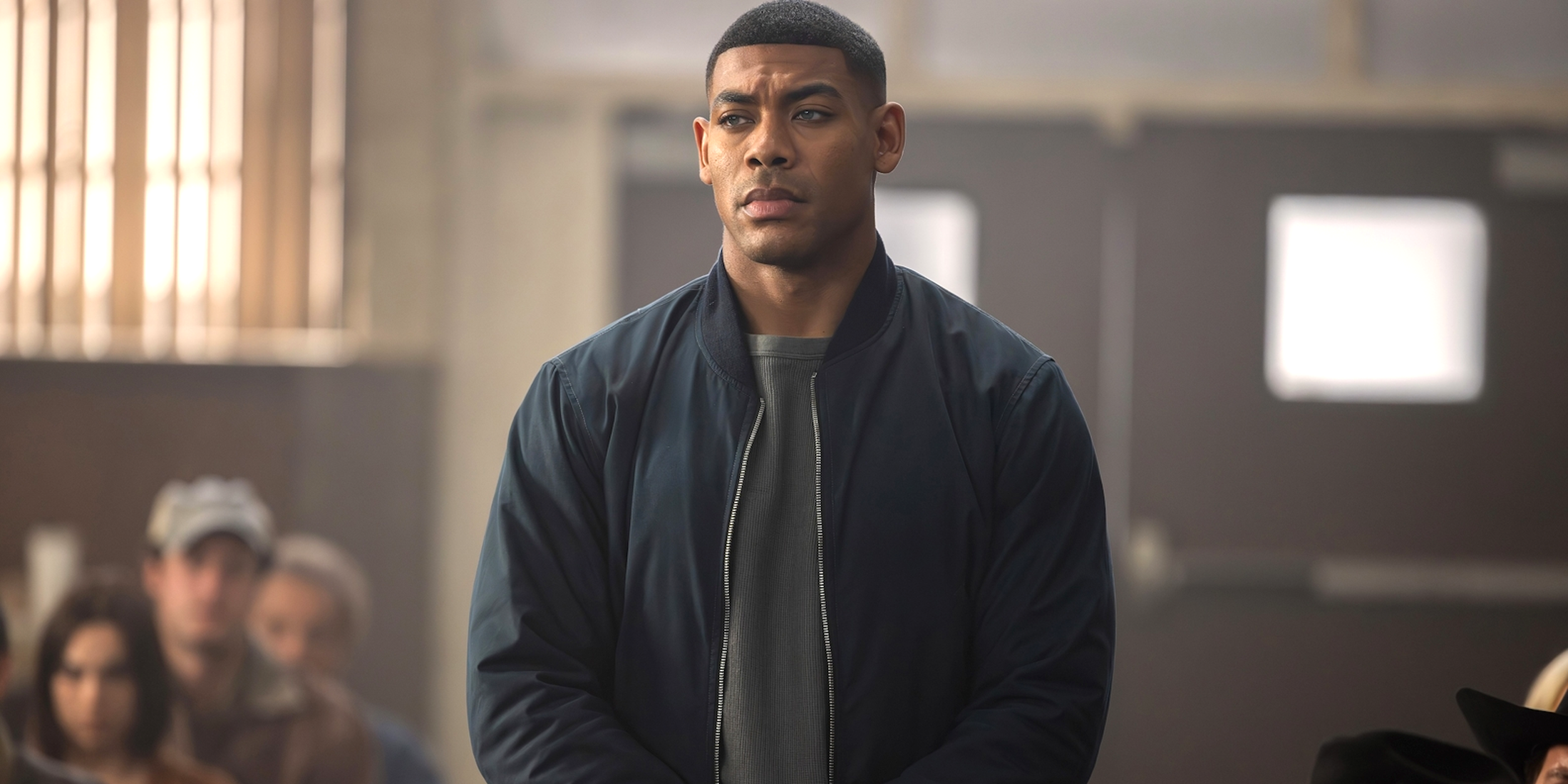
John Stewart has already been through a lot by the time the first episode of Lanterns begins. Not only is he several weeks into training under Hal Jordan (Kyle Chandler), a veteran of the Green Lantern Corps and an indisputable hero, but he’s also received informal training via his father’s unique approach to the William Tell story — being that he’d shoot apples off his head with a gun. But nothing could prepare John for the experience he undergoes in the show’s second episode, “Trust Fall.”
John (Aaron Pierre) gets kidnapped by a group of men led by someone called Antaan (Paul Ben-Victor). Though they look like humans, these are in fact survivors of a distant planet, survivors whose presence in Rushville, Nebraska, drew Hal and John back to the rural town and drew the attention of a local militia led by Will Macon (Garret Dillahunt). Antaan threatens to destroy the entire town unless John and Hal give up the identity of their quarry, someone they refer to as a “Manhunter.”
The experience leaves John with one question: What is a Manhunter?
A casual DC Comics fan may think that they have the answer. Surely, the Manhunter in question is J’onn J’onzz, the Martian Manhunter, a mainstay of the DC Comics universe since the late ’50s and a charter member of the Justice League of America.
Yet, Green Lantern fans know that the Manhunter sought by Antaan has nothing to do with the Martian Manhunter. It does, however, have something to do with every other character in the DC Universe with the name “Manhunter,” making for a convoluted backstory filled with retroactive story changes and more than a few digressions.
What Are the Manhunters in the DC Universe?

Before going behind the scenes to see how this story was told, let’s take a look at the history of the Manhunters within the Green Lantern mythos. Manhunters are brutal androids powered by the same emerald energy that allows Hal Jordan and John Stewart to power their rings. Guided by their slogan “No man escapes the Manhunters” (or “No one escapes the Manhunters,” when clarity takes precedence over poetry), the Manhunters scour the universe in search of their prey, and they mete out merciless justice.
The Manhunters were something of a rough draft before the creation of the space cops known as the Green Lantern Corps. They were created by the Guardians of the Universe, a race of immortal scientists who, long ago, accidentally introduced evil into the world when one of their number, a researcher called Krona, glimpsed the dawn of creation. To atone for their sins, the Guardians created a peacekeeping force to restore order and protect the innocent. Initially, they left that job to androids called the Manhunters, thinking they would deliver justice without the foibles of a sentient being. But when the Manhunters proved too uncaring, wiping out an entire space sector, the Guardians abandoned the project and formed the Green Lantern Corps, putting limitations on the power and giving rings to fearless people across the galaxy.
The Guardians “abandoned” the Manhunters — they didn’t destroy them. Instead, they left the Manhunters in exile. In response, the Manhunters made their way to various planets, took on the features of their inhabitants, and tried to blend in. On Earth, this led to the founding of the Manhunter Cult, a group of fanatics committed to delivering justice and led by the mysterious, mustachioed Grandmaster. The Manhunter Cult recruited several humans who took the name Manhunter and became allies of the Justice League and even Hal Jordan, including Mark Shaw, Paul Kirk, and his clone, Kirk DePaul.
However, the Manhunters never abandoned their hatred of the Green Lantern Corps. So when the Guardians relocated several Green Lanterns to Earth at the turn of the century, in anticipation of an advance in human evolution that would change the universe, the Manhunters increased their efforts by replacing key people in the superheroes’ lives with android doppelgängers.
Thus, Commissioner Gordon, Superman’s childhood friend Pete Ross, and the Flash’s father Rudy West were all, in fact, secretly Manhunters. The heroes turned the tide, and now the Manhunters tend to remain in their robot form. However, that doesn’t stop new humans from taking the name Manhunter to fight crime. Most recently, that human was district attorney Kate Spencer, who repurposed a suit worn by the Darkstars — a sort of rival Green Lantern Corps — to become the latest Manhunter.
So, in short, the Manhunter in Lanterns is probably just a killer android designed by the Guardians and disguised as a human. Other people who call themselves Manhunter exist in the DC Universe, but none of them are enemies of the Green Lanterns, and none of them are the Martian Manhunter either.
The Strange Story of the Manhunters

The answer to how all of this happened is “retroactive continuity,” or “retcons.” In comic books, a retcon occurs when a new story comes out that changes key details of an old story. For example, Superman couldn’t fly and worked for the Daily Star in his first appearance in Action Comics #1 from 1938. Later, when his origin was retold, Superman could fly from a young age and Clark Kent always worked for the Daily Planet. The continuity was changed retroactively.
Few concepts in DC Comics have experienced as many retcons as the Manhunters, partially because the name was messy from the beginning. 1941’s Adventure Comics #58 features a story by Ed Moore called “Paul Kirk, Manhunter: Manhunt on the Sun Limited.” There, and in the adventures to follow across the next year, Kirk is simply a plain-clothes detective who takes various dangerous assignments to find sneaky criminals.
In 1942, DC (then called National Comics) decided to replace Paul Kirk’s stories with those of a more traditional superhero. Adventure Comics #73 saw a story by Jack Kirby and Joe Simon, the creators of Captain America, that introduced Rick Nelson, a big game hunter who starts fighting crime under the name Manhunter. Making matters more complicated, another company called Quality Comics introduced a third hero called Manhunter around the same time — a testament to just how tangled the name’s comic book history had become before the Green Lantern mythology ever folded it into something cohesive.