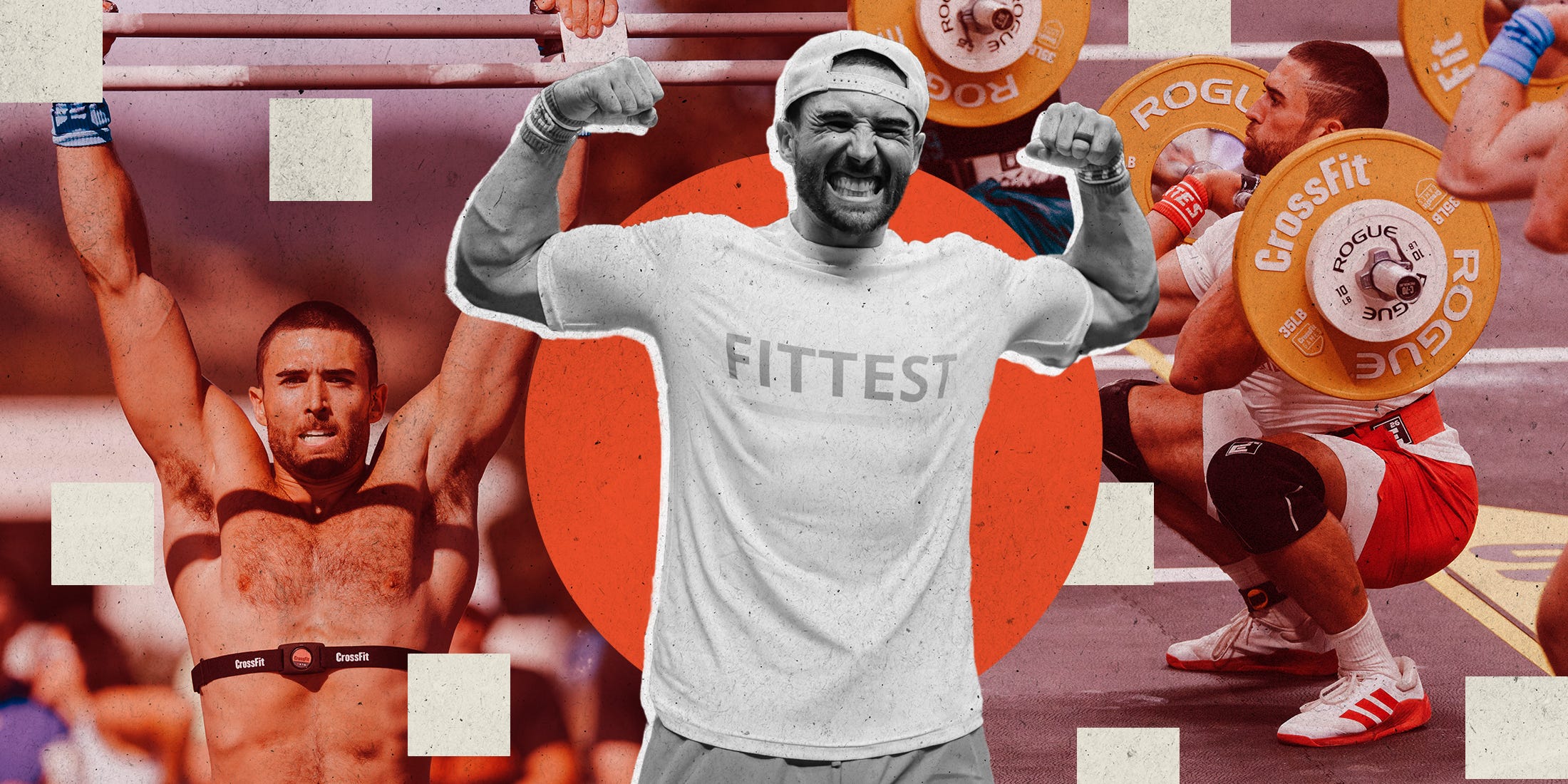

At just 24 years old, James Sprague has already reached the top of CrossFit. Twice.
He first earned the title of Fittest Man on Earth in 2024, completing a rise through the sport that began when he discovered CrossFit at 12. But the championship came under circumstances no athlete could have prepared for: Competitor Lazar Đukić died during the opening event of the Games, casting a shadow over the competition and leaving Sprague struggling to reconcile his win with the tragedy surrounding it.
Two years later, Sprague won again.
At the 2026 CrossFit Games in San Jose, California, the Adidas athlete took on the most expansive individual competition in Games history: 20 scored events designed to test virtually every dimension of fitness, from strength and gymnastics to endurance, speed, and power. Sprague finished with 1,318 points, holding off Dallin Pepper by just 27 points to become a two-time champion.
The win was built less on outright domination than relentless consistency. Sprague remained near the top of the leaderboard across four days of competition, held off repeated challenges from Pepper, and entered the final event still needing to protect his lead. A 10th-place finish was enough. Sprague was the Fittest Man on Earth once again.
Sprague has also emerged as part of a generation tasked with carrying CrossFit forward at a crucial moment for the sport. The 2026 Games marked its 20th edition. Hyrox and other hybrid competitions are booming. Run clubs have turned recreational endurance into social competition, and CrossFit itself is confronting questions about accessibility, affordability, and how to attract new athletes without abandoning the methodology that built it.
Men’s Health connected with Sprague via Adidas following his second Games victory to talk about how he trained for the biggest test of his career, the confidence he believes separates him from the field, and where CrossFit goes from here.
”This Felt Like Something I Could Celebrate”
MEN’S HEALTH: You won your first CrossFit Games in 2024, and now you’ve done it again in 2026. How does becoming a two-time champion feel different from becoming a champion for the first time?
JAMES SPRAGUE: The first time I became a champion, it was under a circumstance that I didn’t imagine becoming a champion under. We had a tragedy happen at the CrossFit Games where one of our friends and competitors passed away in an event. There wasn’t a lot to be happy about. Even though I achieved this goal that I’ve set out my entire life and wrapped my entire life around being able to achieve, it didn’t feel like I achieved it. This year, under a healthy environment, with everyone safe and the competitors enjoying themselves and the atmosphere brighter and happier, this felt like something I could celebrate and really dwell on and be proud of.
Shifting from Chaser to the One Being Chased
MH: After winning in 2024, you went from chasing the title to being the guy everyone was chasing. How did that change your approach?
JS: The first time I had a breakthrough, which was right before the 2024 win, I started to realize, “Hey, people are trying to beat me now,” and I need to see myself as setting the standard for what’s possible in workouts. When I go into each individual competition or workout, how can I maximize my own performance and not compare it to anyone else’s? It came down to self-belief. My training is going well. I’m going to continue getting better. As long as I have that self-belief and my training continues to get better, there’s no reason I shouldn’t be confident enough to stand on top.
Training for 20 Events
MH: What did preparation for the 2026 Games actually look like? Where did you need to become a better athlete?
JS: CrossFit is a mix of strength, gymnastics, and monostructural cardio work, so you have to be well-versed in all fields. It’s the complete Superman of athletes, being a CrossFit Games athlete. I hold my own on all the monostructural stuff, and I’m pretty good at gymnastics. When it comes to top-end strength, that’s where I lack compared to the other guys. Most of my training is centered around that weakness. I’ve been very adamant about attacking my strength and making that a priority: heavy lifts, a lot of muscle accessory work, a lot of hypertrophy stuff just to get bigger, stronger muscles, and then I work a lot on my Olympic lifting. But in 2026, I knew the CrossFit Games were going to be a different beast having 20 tests. In years prior, we had anywhere between 10 to 12. This year being 20, I amped up my volume a lot. I made sure I was getting outside the box, doing weird things. Anything that could come up, I tried to do. I ran up hills. I did a lot more swimming. I went to the track more. I tried to get creative more than I ever have for this Games season.

What Separates Him from the Field
MH: At this level, everybody is extraordinarily fit. What ultimately separated you from the field?
JS: Confidence. I truly believe no one can beat me. After proving myself for a few years, I know exactly how to maximize each test and how to get there. When I look at a workout, I roadmap it out in my head. What’s the best possible time? How do I get there? Can I do that? The answer is yes. Then I just have to do it on the floor. I already did it in my head, so now I can do it on the floor. A lot of it is mental — being able to envision and cast that vision out, and then when you step onto the floor, being very locked in on what’s at hand and not letting anything from the crowd or the hype get to your head. I would also say how much I enjoy it. Training has done so much for me. I would even say it saved my life when I was a kid. I was depressed and overweight, and when I started training with my dad, it gave me a sense of hope and purpose.
The Moment He Knew
MH: Was there a moment during the Games when you thought, “I have this”?
JS: After Saturday night’s back-to-back events, events 16 and 17. I knew the Saturday night events I had to attack with all I had and basically close the door on the guy behind me. After doing that, I felt a lot of confidence going into Sunday that I just had to keep running my race. It’s in my control now.
CrossFit at 20 Years
MH: You won your second title as the CrossFit Games celebrated 20 years. Where does CrossFit fit in the larger fitness world today?
Sprague sees CrossFit’s 20th Games as both a milestone and a moment of opportunity. With hybrid fitness competitions growing and more people seeking community-driven training, he believes the sport is well-positioned to bring in a new generation of athletes — as long as it stays true to the broad, demanding methodology that has defined it from the beginning.