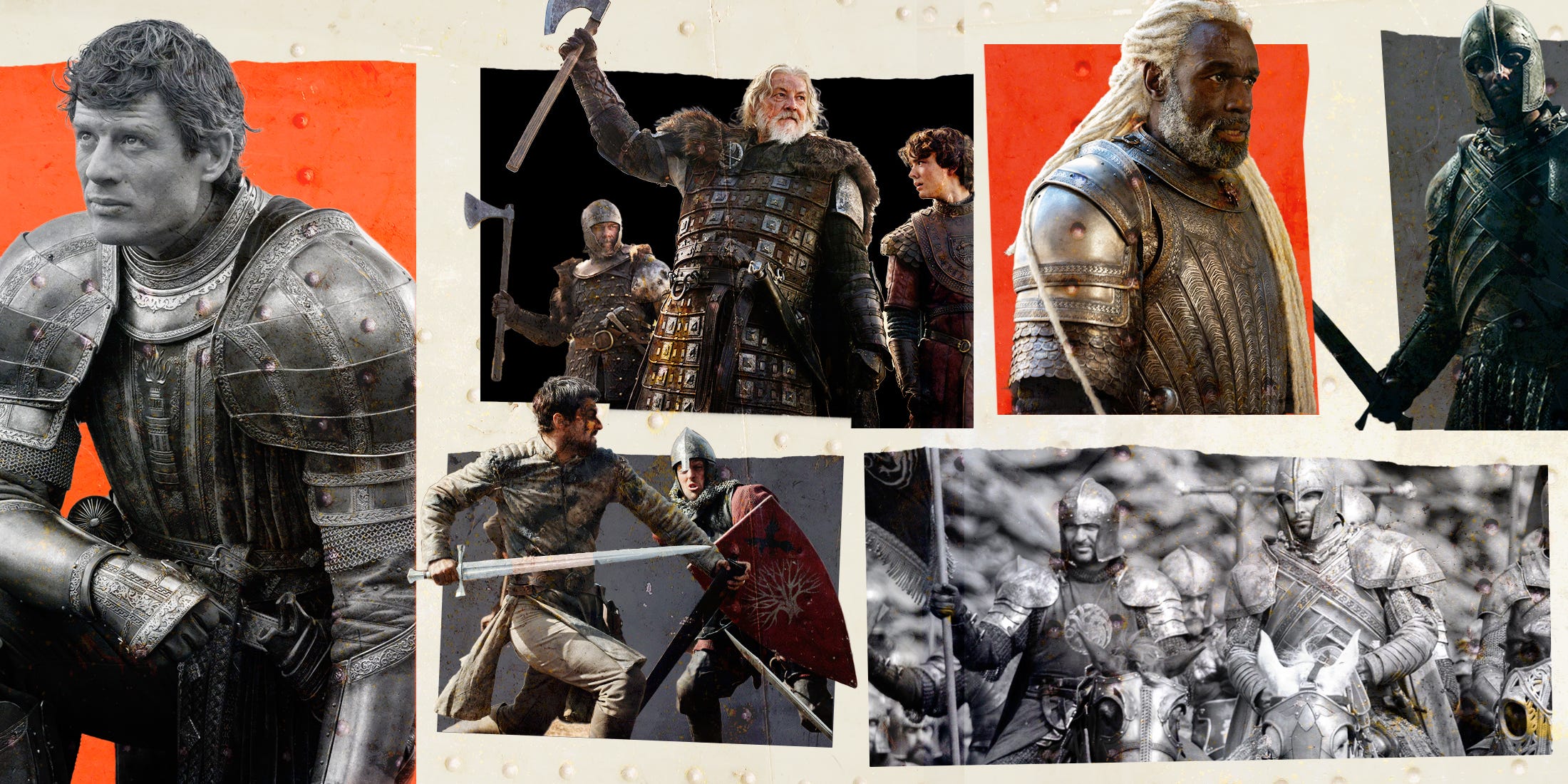

Right from the moment it started airing, HBO’s Game of Thrones never shied away from spectacle. In its eight-season run, the show had a cast of what seemed like thousands, went everywhere on-screen from ice-covered mountains to arid deserts, and aired battle scenes so gory that they inspired eye-popping online reaction. (In addition to actual on-screen eye-popping. Spoiler alert!)
And though it’s only three seasons into its run, the Thrones spinoff, House of the Dragon (based on George R.R. Martin’s Fire & Blood), is already awe-inspiring in its scope and reach. Not only are there multiple, terrifying on-screen dragons — big, super detailed ones with storylines and everything — but the show has also hosted its fair share of shiver-inducing bad guys and awe-inspiring battle scenes.
Thanks to savvy CGI work and more than a few well-placed dragons, HOTD’s battles have been some of the franchise’s fiercest. They’ve also been some of the most intricate, thanks in part to the detailed work of the show’s costume and armor teams.

Consider these stats from the show’s on-screen armor designer, Simon Brindle. Over the course of just House of the Dragon’s eight-episode third season, Brindle says his team used over 400,000 chain mail links and 100,000 solid dome rivets, mostly in service of creating armor pieces for principal characters like Ser Criston Cole and Daemon Targaryen. Brindle says his team also crafted 25,000 custom, laser-cut pieces of metal for its armor this season, some of which — like the chest piece worn by new villain Ormund Hightower — were incredibly detailed.
If that sounds like a lot, it’s because it is, especially when you consider Brindle’s team is also producing additional armor pieces for background characters and extras. That doesn’t mean they get to cut corners, however. “We work really hard and everyone puts 110 percent in, but it’s not so much about quantity,” Brindle says. “Instead, it’s very much about quality. Everyone is very driven to do the best they can for us, which makes for remarkable things.”
With season 3’s biggest (and bloodiest) battles still on the show’s dragon-filled horizon, here’s what Brindle and House of the Dragon costume designer Caroline McCall say they do in order to make their show and its armor really shine.
Designing Ormund Hightower’s Armor
Men’s Health: Let’s start with Ormund Hightower, a new character spectacularly played by James Norton. How did you go about defining how his armor would appear?
Caroline McCall: I start with the script and a lot of research. With Ormund, we’ve seen the Hightowers before, but his character comes in and is so famous. He’s also a big defender of the Faith of the Seven. I was also thinking about Old Town, which we’ve not visited yet, but know that the Hightowers live there and that they’re a really wealthy house. There are so many houses in Westeros wealthier than the Targaryens.

Before every season, I go to all the museums in London that have beautiful armor and artifacts. At the Victoria and Albert Museum, I was struck by this bust of an Italian commander from the 1400s that was actually made as a throwback to Roman times. It had this particular shape of helmet I really liked, and so when I talked to Ryan Condal, Dragon’s showrunner, about what we wanted to do, I referenced Italian Renaissance armor because it was so expensive to produce and so beautifully detailed.
I had this idea that Ormund would wear his faith upon his armor, too, and so I worked with our concept artist on how we could represent the Faith of the Seven in a medieval aesthetic. After that, Simon’s process begins, because I might draw something that’s not technically possible or he might say “Well, this is more outside of our period,” because we try really hard to root what we’re doing in the possibilities of the time period we’re in. We’re not trying to create a fantasy series. We’re trying to create a reality that also just happens to have dragons in it.
Establishing the Show’s Historical Time Period
MH: What time period do you envision for the show?
CM: We’re looking around the 1300s or 1400s in terms of the technology. With Game of Thrones, which is set after House of the Dragon, we were thinking about the Middle Ages too, but in that era there weren’t massive advances in technology — so the worlds feel distinct from one another while remaining grounded in a recognizable historical reality. That sense of authenticity is central to everything the costume and armor teams create, from the smallest chain mail link to the grandest ceremonial chest piece.