“An ancient poem! A director! An adaptation! A movie to break the global box office and bring it screaming to the ground!”
In the days since The Odyssey was released, the cultural discourse has been dominated by a single film and its filmmaker to a degree rarely witnessed before. Coming off of 2023’s Oppenheimer, which accomplished the impossible feat of turning a three-hour biopic about a mid-century nuclear physicist into a critically beloved, billion-dollar-grossing Best Picture and Best Director winner, Christopher Nolan set his sights on the only place he had left to go: a story we all had to read in middle school. And once again, he put his magic on display, turning it into a thrilling, star-packed, somehow both ancient and contemporary blockbuster. It also grossed a quarter of a billion dollars in a single weekend.
Much of the rapturous discourse around The Odyssey has focused on the writer/director’s nimble feat of taking Homer’s classic tale and turning it into a Christopher Nolan movie. His Odyssey is focused on a great, hubristic genius, called to duty away from home and family, who must face down great challenges that test his body, mind, and soul — which he achieves — and in the process unwittingly contributes to the slow dissolution of civility and society. This doesn’t so much graft story onto The Odyssey as it makes the viewer realize that basically every Christopher Nolan film — and really most western stories — have always been The Odyssey. Still, Nolan manages to find threads and points of emphasis that make the often-retold structure feel particularly Nolanesque.
There has been less discussion around how The Odyssey is, in many ways, a real departure for the puzzle-loving, timeline-shuffling auteur. The sturdy epic is picaresque, by necessity episodic, and while most of Nolan’s films are sustained tone poems that offer his atmosphere-rich takes on superhero films (The Dark Knight trilogy), or Bond films (Tenet), or war films (Dunkirk), or science fiction (Interstellar, Inception), or the biopic (Oppenheimer), The Odyssey works in vignettes that allow for wild swings in mood and style — a gymnasium that offers space for experimentation with entirely new genres. What’s remarkable is that it all works without making the film shaggy or dissonant.
The following is a cataloging of some of the different types of films Nolan has managed to smuggle into his making of The Odyssey, turning the film itself into something not far off from the very Trojan Horse he depicts in the film’s opening moments — disguised as a conventional gift to the box office gods.
Sword-and-Sandal Creature Feature

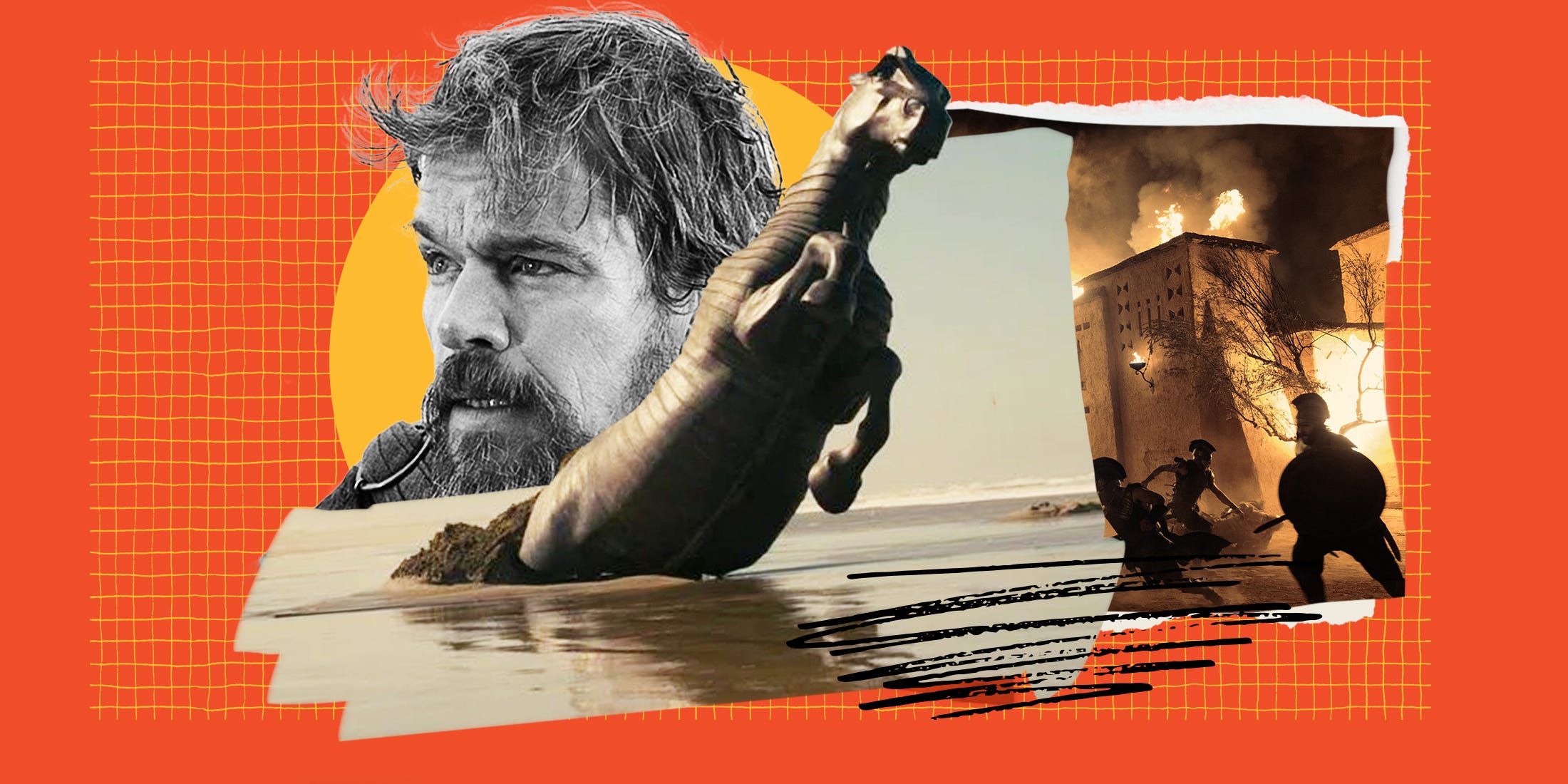
By the time the sea monster Scylla’s giant tentacles descend from a cave, plucking men off Odysseus’s ship as it sails along the alternate route he’s chosen to avoid an apocalyptic whirlpool, the audience has already sat through what is, unquestionably, Christopher Nolan’s most fantastical film. This is saying a lot for a filmmaker who has given us Tesla cloning machines, a corridor of time and memory designed to torture girl dads, and introduced “temporal pincer movements” into the culture. On Odysseus’s journey we meet a Raimi-worthy army of the dead who rise from mud, a horde of terrifying, invincible Laestrygonians punching through trees and tearing ships apart with their bare hands, along with both Circe the witch and Polyphemus the cyclops. In its cavalcade of fantastical creatures — most of whom are achieved with practical effects — Nolan is iterating on matinee classics like Don Chaffey’s Jason and the Argonauts, bringing the sword-and-sandal creature feature roaring back to the mainstream with the full weight of a modern blockbuster budget behind it.